 Gopulse
Gopulse swaps required separate approval gas for an unapproved PRC20 input on GoPulseX
Gopulse swaps through GoPulseX required separate approval gas when a PRC20 token lacked sufficient spending authorization. That first transaction granted the router permission to use the token; the later swap exchanged it. The wallet also needed PLS for network fees, independent of its token balance. The original suite subsequently announced a June 1 shutdown without naming a year. A confirmed approval alone did not complete the trade.
The short version: An existing sufficient allowance avoided another approval charge, while the later GoPulseX swap still required its own PLS gas.
PulseChain balances and approval readiness
A first GoPulseX trade with a PRC20 input required a balance covering the intended input on PulseChain, sufficient PLS for gas, and authorization for the relevant spending contract. PRC20 was the token designation used in that legacy approval flow. PLS was the network’s native coin and paid the transaction fees. Holding the input token did not automatically supply that gas balance. Network selection also mattered: a balance displayed on another chain could not fund the same transaction on PulseChain.
Readiness depended on the actual token contract and remaining allowance, the amount the spender could use. A wallet connection alone did not establish this permission. For a previously submitted approval, the confirmed allowance provided evidence of authorization. A pending wallet request or transaction identifier did not establish the same state.
Authorization before token exchange
The approval recorded how much of the input token the GoPulseX spender could use. For a first PRC20 trade without an existing approval, GoPulseX required separate approval and swap transactions. Each changed a different part of the wallet’s on-chain state, so both carried their own execution charge.
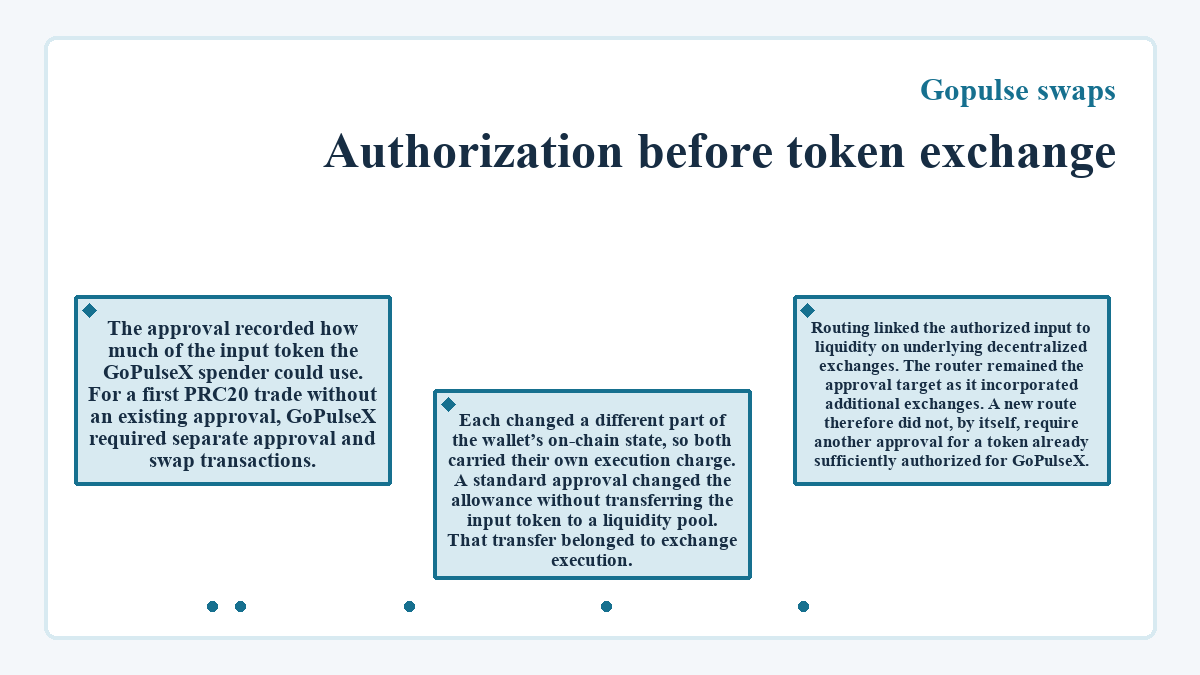
A standard approval changed the allowance without transferring the input token to a liquidity pool. That transfer belonged to exchange execution.
Routing linked the authorized input to liquidity on underlying decentralized exchanges. The router remained the approval target as it incorporated additional exchanges. A new route therefore did not, by itself, require another approval for a token already sufficiently authorized for GoPulseX.
How much did a first PRC20 approval cost?
GoPulseX advertised PRC20 approvals as costing less than $0.01 in gas, separately from the subsequent swap. It also described most swaps as costing less than $0.01 in gas. Those historical dollar figures did not set a fixed PLS budget for every trade.
The actual network charge followed gas consumed multiplied by the effective gas price. Converting that PLS charge into dollars added the coin’s market price as another input. Contract execution and network conditions therefore governed the fee; the dollar value of the traded token was a different quantity. An approval and a swap could consume different amounts of gas, even when they concerned the same input token.
Liquidity-provider fees belonged to the exchange route. Approval gas paid for changing token permission on the network. Comparing those costs required keeping their units and purposes separate, rather than treating a small approval charge as the total expense of acquiring the output token.
A first trade with insufficient authorization added approval gas to the swap’s gas requirement. A later trade with adequate remaining authorization could avoid that additional approval transaction.
A first approval and a sufficient allowance
Assume a wallet held the selected PRC20 input on PulseChain and enough PLS for the required transactions. For that same token and spending contract, the first choice depended on the remaining allowance. An insufficient allowance required approval; sufficient authorization removed the need for another approval transaction for that amount.
- Confirm the selected token, spending contract, and intended input amount matched the allowance being examined.
- If authorization was insufficient, include the approval’s estimated PLS fee before considering the subsequent swap gas.
- If authorization already covered the input, another approval transaction was unnecessary for that amount.
- After an approval completed, confirm the allowance covered the input and enough PLS remained for the swap.
- If the input amount changed, recheck the token balance, allowance, and required gas. Recheck authorization for a changed spender, and review any changed output quote before submitting the swap.
Declining the approval before submission left the on-chain permission unchanged. After a confirmed approval, stopping before the swap left the trade unexecuted while retaining the authorization.
Quoted output and simulated swap gas
GoPulseX compared expected token output and route fees across multiple liquidity sources, including PulseX V1 and V2. Its interface displayed connector tokens and output amounts for the analyzed routes. GoPulseX simulated swaps before broadcasting them to estimate gas fees. The route determined the exchange path, while gas paid for executing the transaction.
Time spent waiting for approval separated an earlier quote from the later swap. Pool prices and available liquidity could change during that interval. A refreshed output estimate therefore mattered after authorization completed. Neither the approval fee nor an earlier route quote established how many output tokens the later exchange would deliver.
Spending permission and custody
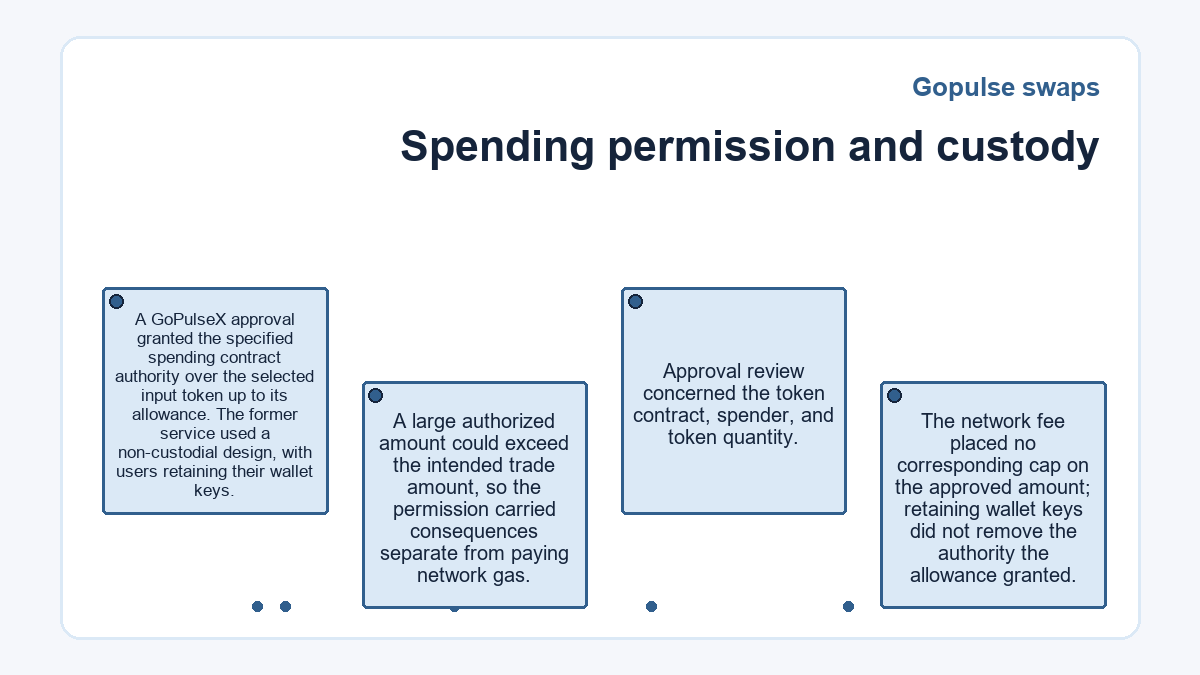
A GoPulseX approval granted the specified spending contract authority over the selected input token up to its allowance. The former service used a non-custodial design, with users retaining their wallet keys. A large authorized amount could exceed the intended trade amount, so the permission carried consequences separate from paying network gas. Approval review concerned the token contract, spender, and token quantity. The network fee placed no corresponding cap on the approved amount; retaining wallet keys did not remove the authority the allowance granted.
What proved that a swap had finished?
A successful swap receipt and confirmed delivery of the selected output asset to the intended wallet established exchange completion beyond the earlier approval. The receipt identified whether the transaction succeeded. For a standard PRC20 output, the receipt’s transfer logs identified the recipient and amount. An approval receipt instead concerned authorization for the input token. A transaction hash alone did not prove success, and the quoted output remained an estimate until execution.
Local portfolio records and browser swap history offered context; the chain recorded the exchange and its token movements.
GoPulseX routing and the separate PLS buying service
GoPulseX exchanged tokens already on PulseChain, while the separate PLS buying service handled cryptocurrency entry and exit across supported networks. These functions answered different first-session needs. A GoPulseX trade with a PRC20 input needed spending authorization for that token and PLS for gas. Obtaining native PLS through the buying service addressed the funding side of entering the ecosystem.
The buying service used a recipient address for native PLS delivery and did not require a wallet connection for that purchase, while GoPulseX needed permission to spend an existing PRC20 input held on PulseChain. Receiving PLS through the separate service did not grant a spending allowance over a token already in the wallet.
The fee comparison followed the chosen action: funding an exchange from another network involved that network’s transaction requirements. Trading through the legacy PulseChain router involved its swap costs and any required PRC20 approval gas.
Legacy permissions after the shutdown
The original suite’s announced June 1 shutdown made its first-session instructions historical rather than a route to assume remained available. The notice did not specify a year. An allowance for the old spender also did not authorize a different replacement contract.
The shutdown itself did not revoke an on-chain token allowance. Reducing or revoking a surviving standard allowance involved another on-chain permission update, which carried its own gas cost. Changing permission could limit future spending authority; it did not reverse a completed exchange or return the gas already spent on approval.
Helpful answers
Which wallet address held a confirmed GoPulseX approval?
The approval belonged to the wallet address that authorized the spender for that token. Switching to another account did not transfer the allowance, even within the same wallet application. A first-trade permission check therefore concerned the selected account’s allowance on PulseChain, rather than an approval associated with a different address.
Why could an earlier token approval become insufficient?
A finite allowance could fall as the spender used it for token transfers. An increased input amount could also exceed the remaining permission. A historical approval therefore did not establish unlimited future authorization. The relevant amount was what the token contract still allowed the spender to use for the selected account.
Could a changed swap quote undo a confirmed approval?
A changed quote did not itself undo a confirmed token allowance. The quote described proposed exchange output, while the allowance recorded spending permission in the token contract. A less attractive quote could justify stopping before the swap, even though the approval remained in place and its network fee had already been paid.
Was approval necessary merely to receive the output token?
A standard PRC20 output transfer did not require the recipient to approve GoPulseX for that token. The approval concerned the input the router would take from the wallet. Using the received token as input in a later trade raised a separate question about its own spending allowance.
How did rejecting an unsigned approval request affect gas costs?
Rejecting an approval request before signing and submission incurred no network gas fee for that unsent request. The network had not executed an allowance change. This stop point differed from abandoning the swap after an approval had already confirmed, when the earlier authorization transaction had consumed gas.
Did a failed swap refund an earlier approval fee?
A failed later swap did not refund gas spent on a previously successful approval. The approval was a separate completed transaction. A swap that reached on-chain execution could also consume gas despite reverting, while a wallet request rejected before submission incurred no execution fee. The failure’s stage determined which network costs existed.
Would clearing browser data remove a legacy GoPulseX allowance?
Clearing browser data did not revoke an on-chain token allowance. Browser storage and contract permission were separate records, so removing local swap history did not withdraw the spender’s authority. Changing a standard allowance required an on-chain permission update, with its own gas cost, rather than deletion of data stored on the device.
Were registration fees part of a first GoPulseX token trade?
GoPulseX required no account registration for a first PRC20 trade. The approval fee paid for network execution, independently of access to the former interface.
Last updated -