 Gopulse
 combined PulseChain portfolio tools and swap routing in one suite
Gopulse combined PulseChain portfolio tracking, PLS buying, HEX stake tools, and token swaps in a single suite. The project later reported that it shut down on June 1, without specifying a year. Its former functions covered viewing holdings, obtaining the network’s native coin, managing stakes, and comparing exchange routes.
Key takeaway: Gopulse’s portfolio views tracked holdings, while GoPulseX sourced swap routes from exchanges supplying PulseChain liquidity.
The PulseChain suite beyond trading
Network statistics were the suite’s starting point in May 2023, before it expanded into asset tracking and transaction interfaces. Those functions answered different needs: a portfolio view organized holdings, a buying service supplied PLS, and GoPulseX compared token exchange routes. HEX stake management added another distinct function alongside those tools.
Portfolio balances and address lookup
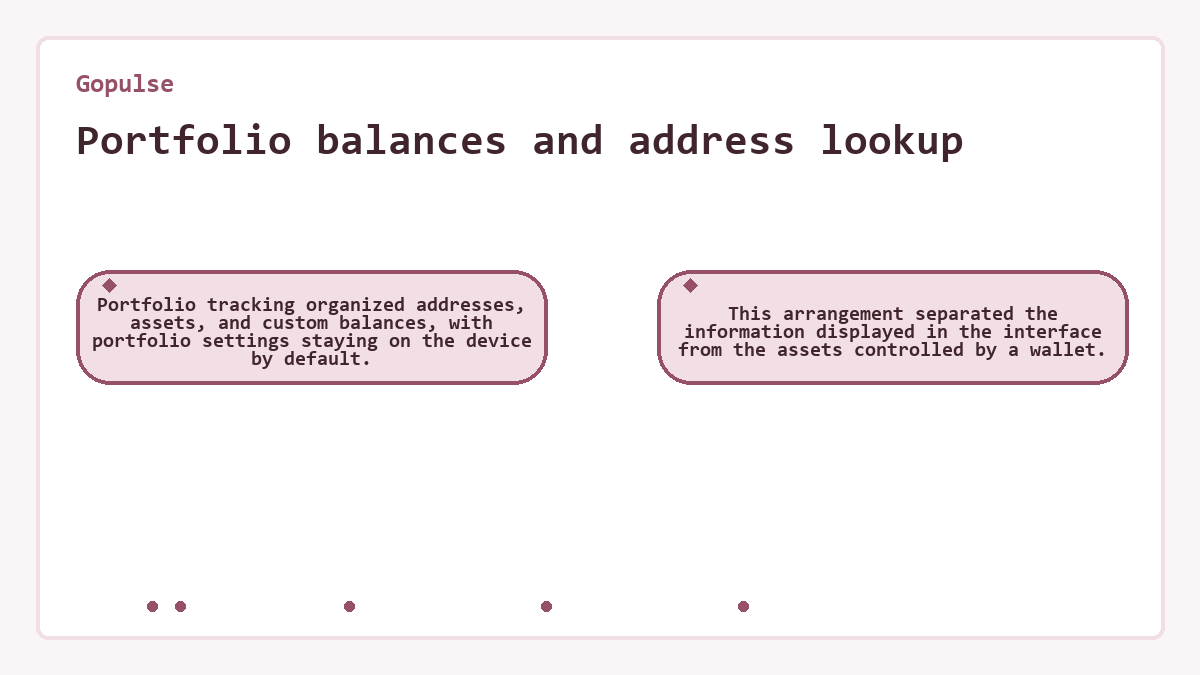
Portfolio tracking organized addresses, assets, and custom balances, with portfolio settings staying on the device by default. This arrangement separated the information displayed in the interface from the assets controlled by a wallet.
Address-based tracking
The address lookup feature allowed inspection of an address through the portfolio interface. It offered a way to examine holdings without treating the address as an account controlled by the viewer. The portfolio-based lookup was a temporary solution, with a fuller explorer discussed as a possible expansion.
Optional device synchronization
Synchronization allowed the same portfolio settings to appear across devices. Activating it let locally stored data leave the original device. An eight-digit portfolio ID gave its holder access to view and edit the synchronized portfolio. That access concerned the portfolio’s addresses and settings, not authority to spend wallet funds. Sharing the ID therefore exposed the organization of a portfolio even though it did not transfer asset custody.
PLS entry and exit routes
The buying service exchanged other cryptocurrencies for native PLS and supported the reverse direction for selling PLS. An on-ramp brought funds into the ecosystem; an off-ramp moved value out through a supported exchange route.
Cryptocurrency funding
The crypto-funded route accepted assets from supported networks, including Bitcoin, Ethereum, Monero, and PulseChain. Gopulse supplied the interface, while an exchange partner handled the backend swaps. The route delivered native PLS, the coin used to pay PulseChain transaction fees. This funding route and GoPulseX’s PulseChain token trading belonged to separate functions, even though both involved exchanging assets.
Card-funded entry through ETH
The card-funded route began with purchasing ETH through a separate provider, then exchanging that ETH for PLS. The purchase and the later exchange had different service roles. The process also required leaving some ETH for transaction fees. The chosen provider handled the card purchase and its payment conditions. Gopulse’s exchange interface handled the subsequent ETH-to-PLS funding route.
How did GoPulseX choose a swap route?
GoPulseX compared quotes and fees across PulseChain markets, then selected a route based on the quoted exchange outcome. It aggregated access to decentralized exchanges, or DEXs, and automated market makers, which used liquidity pools to price exchanges.
The route display included connector tokens and quoted output amounts. Connector tokens linked parts of a route when the selected input and output needed an intermediate asset. The quoted output described the proposed trade, while subsequent market movement could affect execution.
PulseX V1 and V2 supplied important liquidity for the router. Aggregation and pool operation had different roles: GoPulseX compared routes, while the selected exchanges supplied the liquidity. Routing through PulseX could also contribute to PLSX buying and burning. The PLS burn associated with swaps depended on network usage, so it did not represent a fixed amount for every trade.
Transaction simulation helped estimate gas costs before broadcasting a swap, and the interface allowed users to customize gas settings. Network gas and the fees associated with an exchange route were separate inputs. The tools carried no access charge. Swaps still incurred network gas and the costs of their chosen exchange route.
Gopulse Tools for PulseChain Portfolios and Swaps
- How did GoPulseX choose a swap route?
- HEX stake tools and navigation shortcuts
- What did privacy mean for the suite?
- Shutdown and replacement choices
GoPulseX also included automatic protection against transaction-ordering attacks in its feature set. MEV, or maximal extractable value, concerns value gained through the inclusion and ordering of transactions. Sandwich attacks place trades around another swap to exploit its price movement. Such protection addressed an execution risk distinct from holding wallet keys or comparing liquidity.
HEX stake tools and navigation shortcuts
The HEX frontend gave the suite a dedicated interface for managing HEX stakes alongside its portfolio and trading functions. A token balance and a stake represented different information, so viewing holdings did not replace stake management. Keyboard shortcuts addressed navigation across the suite. On desktop, K opened the shortcut overview, arrow keys selected an entry, and Enter activated it. Users could search for shortcuts or select them with the cursor, and memorized hotkeys allowed direct navigation.
What did privacy mean for the suite?
Privacy involved account-free access and local interface records, while public blockchain activity remained visible. GoPulseX used a non-custodial design, which left users in control of their wallet keys and assets. Its no-registration approach concerned access to the trading interface. Optional portfolio synchronization had a separate data boundary because activating it allowed portfolio information to leave the device.
Local storage and on-chain visibility also applied to different records. A browser could retain a portfolio configuration or recent swap list locally. The blockchain recorded the underlying swaps independently of that browser data. Clearing an interface record therefore changed what the browser retained, without erasing public transaction activity.
Shutdown and replacement choices
Gopulse reported that it shut down on June 1, without identifying a year in the notice. Its earlier feature descriptions concerned that former suite. A replacement needed to supply the particular function being sought, whether tracking balances, obtaining PLS, managing HEX stakes, or exchanging PulseChain tokens.
A portfolio display and a swap router met different needs. Seeing assets associated with an address did not supply an executable exchange route. A replacement chosen for tracking could therefore leave funding, trading, or stake management uncovered. Match the next tool to the task:
- For viewing holdings, choose address-based tracking with the assets and balances the task requires.
- For access across devices, distinguish local portfolio settings from settings shared through synchronization.
- For obtaining PLS, distinguish cryptocurrency funding from the card-funded route through ETH.
- For exchanging PulseChain tokens, identify the routing function and the liquidity supplying the trade.
- For managing HEX stakes, use stake controls rather than relying on a token balance display.
Practical questions about Gopulse
-
Was connecting a wallet required for a crypto-funded PLS purchase?
- The former crypto-funded buying route accepted a recipient wallet address without requiring a wallet connection. GoPulseX’s wallet-based token swaps used a different access flow.
-
How long did the crypto exchange route usually take?
- Crypto-funded exchanges typically took around 5-20 minutes, depending on the originating blockchain. This historical estimate applied to the funding route and did not set GoPulseX’s on-chain swap timing.
-
Did a crypto-funded PLS purchase require a separate claim?
- The former buying route delivered native PLS without a separate bridged-asset claim or unwrapping step. That condition belonged to this purchase method, not every bridge or funding service.
-
How many devices could share a Gopulse portfolio ID?
- The former synchronization feature allowed the same portfolio ID across as many devices as the user wanted. It synchronized portfolio information, including tracked addresses and custom balances. It did not create another wallet or give the additional devices spending authority through the portfolio ID.
-
Why did an imported token lack a GoPulseX price chart?
- The former GoPulseX interface did not show price charts for imported tokens. Choosing a stablecoin as the output also prevented that chart view. These display limits were separate from the router’s ability to quote a token exchange.
-
Would adding another exchange require a new approval for the same token?
- Adding an exchange did not itself require a new approval for a token already approved for GoPulseX. The approval concerned that token through the router and did not authorize the other wallet assets.
-
What was GoPulseX’s local swap history limit?
- GoPulseX kept only the last 30 swaps in its locally stored history. Clearing browser data removed that list, while the underlying transactions remained visible on-chain.
-
Were Ethereum swaps part of GoPulseX’s available features?
- The GoPulseX FAQ listed Ethereum trading as unavailable and described it as a planned expansion. Gopulse’s separate crypto-funded PLS route accepted ETH, which performed a funding role separate from trading tokens on Ethereum.
Last updated -